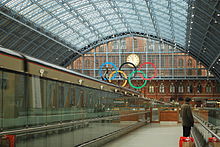
It was on the 6 July 2005, at approximately 12.46pm UK time, that the President of the International Olmpic Committee (IOC), Jacques Rogge, said in front of the General Assembly in Singapore - and indeed millions of others across the world - that London would be the host of the olympic games in 2012. In fact, if you want the full quote, he said:
"The Games of the XXX Olympiad in 2012 are awarded to the city of...London."
I remember being at school when the games were announced. A naive 13 year old boy with ambitious dreams to be a journalist, but with little understanding of what the Olympic Games meant. Yes, I had watched previous games, and could remember vividly cheering Kelly Holmes to victory not once, but twice in the 2004 games in Athens. But apart from that, it was merely a sports contest, which I likened to a music concert or a World Cup match. It did not seem to really affect me, and I had no idea about the legacy, the power and the change to the lives of Briton's across the country.
I look back on that moment now and reflect. I remember the cheers and jubilation of the public. The crowds in London going wild, my friends all around me going crazy; I even remember Denise Lewis jumping across her desk at the committee in Singapore, as if she was competing in the final of the 200m hurdles. A flurry of Union Jack flags, streamers and bunting collate to form a pretty important moment in our history.
And by and large, the excitement of the games has not changed over the last seven years. In fact, this year it has really hit home at just how huge this event will be for London, and indeed the country. Excitement has reached fever pitch and already, mums are busy preparing scones, lemonade and sausage rolls for the many street parties that are bound to take place.
But in seems this feeling of joy is being shadowed by a somber feeling of anger and regret as many of the public, from politicians to the media, start waking up to the reality of what the Olympics really means.
Over the last seven years, I have followed the Olympic games with a keen interest. Since the end of Beijing 2008, it is fair to say the attention has turned on London. And in the last few months in particular, it seems that, rather than supporting London 2012, there is a move to condemn and scrutinise it.
Let's start with the Olympic Park. It has regenerated an area that was badly in need of repair. In fact, I would say it has put Stratford and East London back on the map - not for gang crime and poverty, as the usual stories report - but for a location of fantastic sporting facilities, new infrastructure and a cleaner, greener landscape. It is foolish to conceit that the games have not improved the area. But at what cost? A recent Sky News investigation revealed that the true cost of staging the games had reached £12 billion, five times more than the original estimates made by the former Labour government way back when London bid for the games in 2005. Yet even more worrying was the fact, when associated costs are added, the bill could cost ten times the original estimate of £2.37 billion.

Yet it is worth it, right. Or is it? Because recent figures from Visit Britain suggest that tourism figures will only match those of last year, which fell just short of 31 million. Tourism, apart from the sporting legacy of the Olympic Games, has been the main factor in promoting the Olympics. Yet, 7 years ago when the bid was made, tourism experts claimed the Games would do nothing to help increase tourism in the UK. A recent article by The I Paper claimed that the European Tour Operators Association (ETOS) said there was little evidence from previous games to suggest tourism is boosted by the Olympics. They cited reasons such as traffic, congestion, pollution and over-crowding to be the main reasons for people being put off into travelling to London.
Transport chaos is bound to happen. Forget the worry of a security risk, a fault on the underground line is well worth a bet on. Transport for London (TFL) have ploughed £6.5 billion into transport upgrades, extensions to the lines and improvements to the service, to accommodate for the 9 million people who are estimated to be in London for the games. But with ongoing concern over rail bonuses, in which Bob Crow - RMT Union General Secretary - rejected the TFL's latest plans to give a £500 bonus to tube drivers, there are fears that the transport will not be ready in time for the summer, or indeed function. Transport bosses have warned that 3/10 journeys will be affected by traffic, with key areas like London Bridge and Canary Wharf. Even Boris Johnson, current London Major, has even urged travellers to avoid congestion spots, despite backing a recent campaign called "Get Ahead" to promote the use of public transport in London.
And then there is the cost. Travelling around London can be expensive enough, and what with forking out on tickets and numerous ice creams and cool drinks (if the sun does manage to shine), there is the costly experience of trying to book a hotel room. Complaints have been made across the country of extortionate fees for rooms in the many hotels in London. By just comparing rooms at a no-frills hotel branch for example, you will find that a double bedroom in London is 500% more per night than if you were to stay in Kent.
Even the hotel owners are unhappy. Last month, LOCOG - London Organising Committee for the Olympic and Parlaympic Games - put 25% of hotel rooms in London back on sale after over-estimating how many they would need for foreign dignitaries. The travel industry now estimates that the cost of these empty rooms - about 1 million beds in total - will cause a £3.5 billion loss to the tourism industry.
Then there was the ticketing fiasco. Only a quarter of all those who applied for tickets - in their millions, according to official statistics - got tickets for the games. I was one of the unlucky ones, who despite applying for four different events, got nothing. Meanwhile, a recent Daily Mail article pointed out that one man managed to get over £200,000 worth of tickets for various events. Although the LOCOG officials claimed the system was fair, there are many disgruntled fans of the Olympics who will have to watch their favourite athletes compete from their living rooms this summer.
Moving on from the financial concerns of the Olympics, morally, the games have been condemned. International criticism has hit LOCOG after Dow Jones, the chemical giant who has sponsored the IOC since 2010, was handed the contract to build the hi-tech fibre wrap which will surround the Olympic stadium. The chemical group bought Union Carbide in 2001, whose factory in 1984 leaked toxic chemicals in Bhopal, killing up to 15,000 people and seriously injuring thousands of others. The £7 million project has ignited wide-spread anger, and has even resulted in India threatening to withdraw its team from the games. Meredith Alexander, an official for the Commission for a Sustainable London 2012, recently stepped down from her post in anger over the deal.
It seems that just as London gears up for the greatest sporting event in the world, the reality of the games behind the sporting action and celebrations hides the worrying truths of just how make-or-break the Olympics is to the economy, to tourism, to national security and to us as a nation.
But no matter how serious the consequences of the above may have on the Olympics, there is no doubt that it will change our lives. Whether it be the health benefits, the sense of community or the landscape, everyone should feel part of the event.
I am honoured to be representing the games as a Games Maker, one of the lucky few who makes up over 200,000 volunteers and staff for the Olympics. Not only am I incredibly proud and eager to help towards staging this phenomenal event, I truly believe that it will do more good then bad. If you speak to people in the streets, they will tell you that they feel the same, that this year is the year for Britain. A sense of pride, cohesion and jubilation all coming together. And in this day and age, that is something money really cannot buy.
You can read more of my work, including interviews with Bob Crow and former Olympic gold medal winner Ben Hunt-Davis, on my blog: http://thejourknow.blogspot.com/
Pictures Courtesy of Wikipedia
 Network Rail plans to move the current station to a new site to allow more passengers to use the station, and allow for a more reliable, quicker service.